






 Home
HomeHuzhou, Zhejiang, April 22 (Zhang Yuhuan Guo Qiyü) – To celebrate the 49th World Earth Day, on April 22, the Zhejiang Provincial Land and Resources Bureau and the Huzhou Municipal Government held a commemorative event themed on green mining in Renhuangshan Park, Huzhou, to promote the green development of the mining industry and promote ecological civilization construction. Zhang Guobin, Deputy Director of the Zhejiang Provincial Land and Resources Bureau, stated that by the end of 2020, all mines in Zhejiang will meet green mining standards.
It is understood that Zhejiang Province has relatively abundant non-metallic mineral resources and is an important sand and gravel mining base in the Yangtze River Delta region. In recent years, under the pressure of increasingly tight resource constraints and environmental capacity exceeding limits, Zhejiang Province’s mineral development has gradually embarked on a new path of green development, forming unique practices in green mine development and abandoned mine remediation.
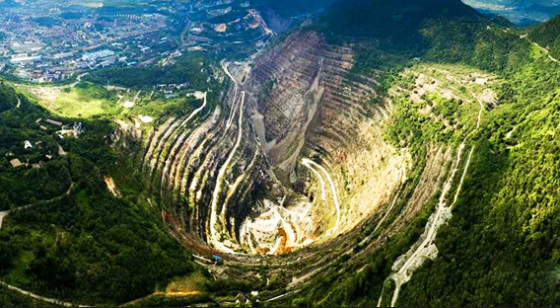
Renhuangshan Park in Huzhou is the best testament to the development of green mining. The current lush Renhuangshan Park was once an abandoned mining area with a remediation area of up to 160,000 square meters. Zhang Guobin introduced that Zhejiang has now built 5 national-level mining parks.
It is understood that “closing down prohibited mining areas, shrinking restricted mining areas, and concentrating mining areas” is a principle consistently adhered to by Zhejiang in mine governance, promoting a gradual reduction in the number of mines and achieving intensive development. At the same time, Zhejiang continues to raise the entry threshold for mines, and was the first in China to formulate entry standards for the mining of stone materials, limestone, fluorite, and talc.
According to Wang Xiaojun, director of the Huzhou Municipal Land and Resources Bureau, at the end of the 1990s, there were more than 600 mining points in Huzhou’s 5,820 square kilometers of land, averaging one mining point for every less than 10 square kilometers. With the advancement of green mining, in 2018, Huzhou had only 47 mines left, and by 2020, the total number of mines in Huzhou will be controlled to 42.
As a pilot construction area for the national green mining development demonstration zone, Wang Xiaojun stated that by 2020, the completion rate of green mines in Huzhou will reach 100%, and the green coverage rate of mining areas will reach 100% of the greenable area.
Currently, there are only more than 900 mines left in the entire province of Zhejiang. Zhang Guobin said that by the end of 2020, all mines in Zhejiang Province will also meet green mining standards.
Regarding whether the reduction in the number of mines can guarantee the resource needs of economic construction and social development, Zhang Guobin stated: “Intensive development results in even higher output; only a scientific mining model can create a sustainable and long-term mechanism.”