








 Home
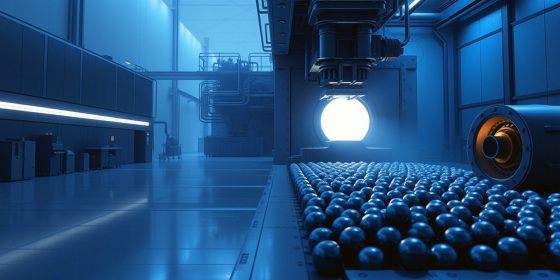
HomeThe main function of steel balls in a ball mill is to impact and crush materials, while also playing a certain grinding role. Therefore, the purpose of steel ball grading is to meet these two requirements. The quality of the crushing effect directly affects the grinding efficiency and ultimately the output of the ball mill. Whether the crushing requirements can be met depends on whether the steel ball grading is reasonable, mainly including the size of the steel balls, the number of ball sizes, and the proportion of various specifications of balls. In addition to considering factors such as the size of the ball mill, the internal structure of the ball mill, and the required product fineness, the characteristics of the raw materials (grindability, particle size, etc.) must also be considered when determining these parameters.
To effectively crush the material, several principles must be followed when determining the grading:
First, the steel balls must have sufficient impact force, so that the ball mill steel balls have enough energy to crush the particulate material, which is directly related to the maximum diameter of the steel balls.
Secondly, the steel balls must have enough impact times on the material, which is related to the steel ball filling rate and average diameter. When the loading amount is constant, under the premise of ensuring sufficient impact force, the diameter of the grinding media is minimized, and the number of steel balls is increased to increase the number of impacts on the material to improve the crushing efficiency.
Finally, the material has sufficient residence time in the mill to ensure that the material is fully crushed, which requires the matched steel balls to have a certain ability to control the material flow rate.
The so-called two-level grading method uses two different sizes of steel balls with a large difference in diameter for grading. The theoretical basis is that the gaps between large balls are filled with small balls to fully improve the packing density of the steel balls. In this way, on the one hand, the impact ability and impact frequency of the mill can be improved, which conforms to the functional characteristics of the grinding media; on the other hand, the higher packing density allows the material to be subjected to a certain degree of grinding. In two-level grading, the main function of large balls is to impact and crush materials; the functions of small balls are: firstly, to fill the gaps between large balls, improve the packing density of the grinding media, control the material flow rate, and increase the grinding ability; secondly, to transfer energy, transferring the impact energy of large balls to the material; thirdly, to squeeze out coarse particles in the gaps and place them in the impact zone of large balls.
The two-level grading method needs to determine the following parameters:
(1) Determination of the diameter of the large ball. It depends on the size of the ball mill, the particle size and grindability of the raw materials. Generally, the second-level diameter in multi-level grading is used as a reference. For example, if the maximum diameter of a ball mill is 100 mm in multi-level grading, a steel ball with a diameter of 90 mm should be selected for two-level grading.
(2) Determination of the diameter of the small ball. It depends on the size of the gap between the large balls, that is, it depends on the diameter of the large balls. Usually, the diameter of the small ball is 20%-30% of the diameter of the large ball.
(3) Ratio of large and small balls. In principle, the amount of small balls added should not affect the filling rate of large balls. Generally, small balls account for 3%-5% of the weight of large balls.
In multi-level grading, the requirements for the impact force, impact frequency, and material flow rate control ability of steel balls are mainly based on the average diameter, that is, they are affected by various specifications of balls. In two-level grading, the impact force and impact frequency of steel balls are determined by the diameter of the large balls, while the ability to control the material flow rate is mainly determined by the diameter and loading amount of the small balls, and is less affected by the diameter of the large balls, thus alleviating the contradiction between impact force, impact frequency, and material flow rate control ability. In comparison, the two-level grading method is simpler, and it is easy to comprehensively consider when determining the grading parameters.
As the hardness and particle size of the material increase (which can be reflected by the different proportions of mixed materials), the contradiction between the impact force and material flow rate control ability of steel balls in multi-level grading becomes more prominent, resulting in a more significant decrease in output. However, this contradiction does not exist in two-level grading, because it can meet the material requirements for impact force and flow rate control ability through large and small balls, so the output change is not obvious, reflecting the superiority of two-level grading.
Using two-level grading can also reduce the number of cleaning times. Only regular replenishment is needed according to the ball mill output, current, fineness, and ball consumption ratio of the grinding material. Except for special circumstances, the mill is generally not shut down for cleaning, which improves the operation rate of the ball mill.
Conclusion
When the material particle size is small and the grindability is good, multi-level grading should be used, because improving the impact frequency of steel balls is the main concern. Conversely, when the material particle size is large and the strength is high, improving the impact force of steel balls is the key, so using two-level grading can show obvious advantages.
The effect of the two grading methods is greatly affected by material changes. Multi-level grading is more sensitive to material changes, and the ball mill output fluctuates greatly. Two-level grading is less sensitive to material changes, and the output is relatively stable. In other words, when the grindability of the material is better, the increase in output of multi-level grading is higher than that of two-level grading. Conversely, the degree of output decrease in multi-level grading exceeds that of two-level grading. Therefore, multi-level grading is suitable for materials with smaller particle size and better grindability, while two-level grading is suitable for materials with larger particle size and poorer grindability.