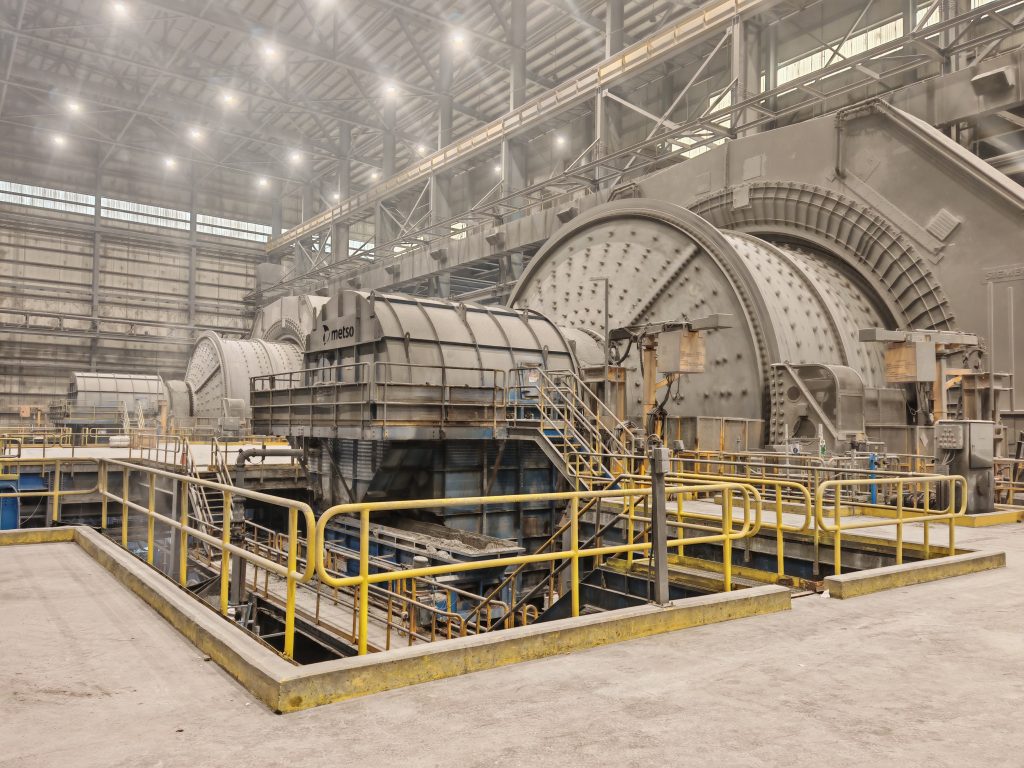
SAG mill throughput hit a ceiling; high ball consumption under heavy loads and insufficient pebble crushing constrained system capacity release
Throughput had remained at 1,000 t/h, grinding ball consumption was high at 0.72 kg/t, and incomplete pebble comminution.
① SAG mill throughput remained stagnant at 1,000t/h with an unexpandable capacity limit;
② Excessive grinding media wear with high consumption (0.72kg/t), driving up wear-resistant part procurement costs;
③ Insufficient ball impact toughness and blow force led to incomplete pebble breakage, restricting total system throughput release.
We achieve optimization through these methods
① Product Customization: Optimized steel chemistry and gradient heat treatment to produce 140 mm forged grinding balls with high toughness and high surface hardness, achieving uniform core-to-surface hardness and dual improvements in breakage resistance and wear resistance;
② Process Matching & Optimization: A professional technical team was stationed on-site to phase out the existing grinding balls over 30 days, while adjusting grinding concentration, implementing time-slot balanced ball recharge, and optimizing ore blending and load distribution to match the mill's 12%–13% ball charge;
③ Full-Process Tracking: Hourly throughput, ball consumption, discharged balls, and broken balls were monitored throughout the trial to dynamically optimize operating parameters.
Using the existing SABC operating conditions as the baseline, the grinding balls were gradually replaced over 30 days, with performance tracked and validated throughout the trial.
Consistent baseline conditions, controlled ball replacement, and dynamic parameter adjustments ensured a fair and comparable evaluation of the new and existing grinding balls.
- On-Site Operating Condition Assessment and Data CollectionVerified the ore hardness, feed particle size, operating parameters and ball filling rate of the 10.97 × 6.3 m SAG mill, as well as the performance of the competitor’s 140 mm forged grinding balls, the existing specific consumption of 0.72 kg/t, and the observed failure modes.
- Customized 140 mm Forged Grinding Balls and Ball Charging PlanOptimized the steel composition and gradient heat treatment process to achieve high toughness, high surface hardness, and uniform hardness from surface to core. Implemented balanced ball replenishment at scheduled intervals to match the mill’s operating conditions at a 12%–13% ball filling rate.
- Controlled On-Site Ball Replacement and Full-Cycle MonitoringA technical team supervised the controlled replacement of existing grinding balls over 30 days, optimized pulp density and mill loading, and monitored throughput, ball consumption, ball discharge, and breakage throughout the trial to refine operating parameters.