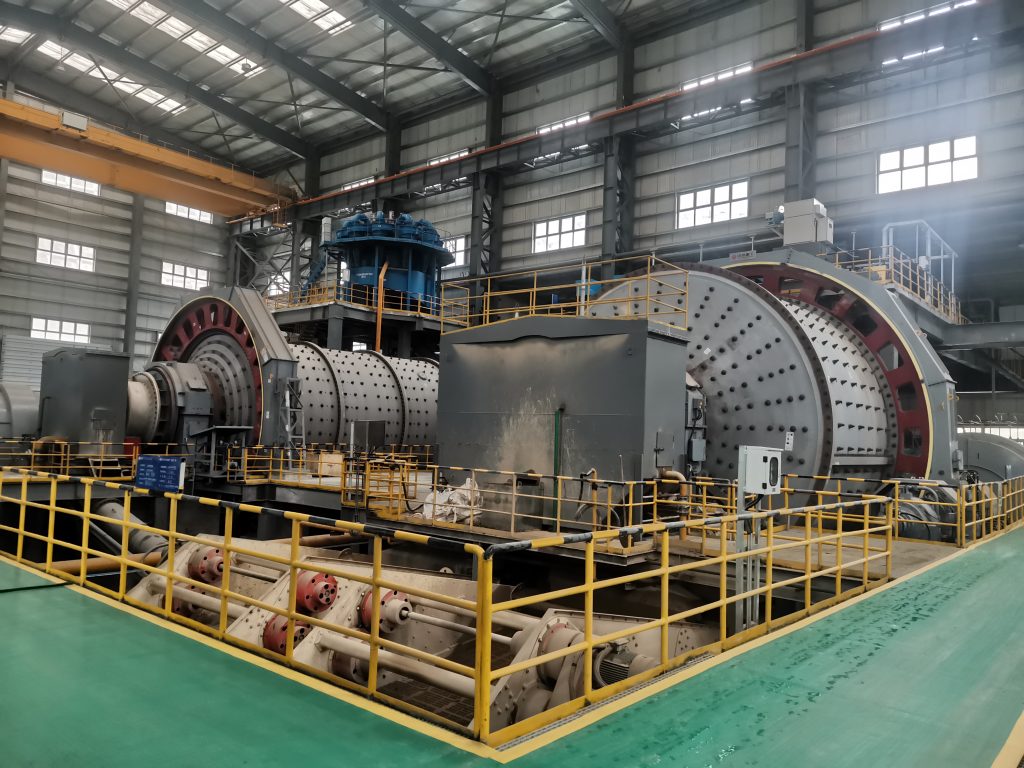
High competitor-ball consumption, fluctuating grind fineness, and frequent manual ball replenishment led to both high consumables costs and heavy on-site maintenance workload.
Mill No. 1: Baseline ball consumption of 0.41 kg/t, fluctuating grind fineness, unstable classification, and extensive manual ball replenishment.
①High grinding ball consumption: Mill No. 1 had a baseline specific consumption of 0.41 kg/t, driving up consumables procurement costs.
②Fluctuating grind fineness and unstable classification compromised mineral liberation and flotation performance.
③Frequent, high-volume manual ball replenishment increased on-site maintenance workload.
We achieve optimization through these methods
①Coarse Grinding: No. 1 mill charged with customized 120 mm Goldpro forged grinding balls.
②Four-Stage Trial: Establish baseline performance →Adjust ball charge to operating conditions → Stabilize operation and collect data → Evaluate results and issue report.
③Continuous SCADA Monitoring: Track discharge particle size distribution, throughput, discharge density, circulating load, power consumption, ball charge, broken ball quantity, mill filling rate, liner condition, screen blockage rate, and full-size-range particle size distribution. Photograph and retain records of broken balls.
Since June 2026, a two-phase trial involving gradual replacement and testing with controlled ball additions has been conducted to determine the optimal ball charging regime.
Continuous monitoring and comparative analysis based on data from the site’s automated control system.
- Establish Baseline Performance and Optimize Operating ConditionsPhase 1: Record baseline mill performance. Phase 2: Adjust the grinding ball charge and optimize the mill to its target operating conditions.
- Stable Operation and Data CollectionPhase 3: Once stable operation is achieved, continuously collect data on throughput, power consumption, mill filling level, discharge particle size distribution, and full-size-range particle size distribution.
- Results Evaluation and Standardization of the Ball Charging RegimePhase 4: Evaluate trial results, prepare the trial report, and standardize the optimal ball charging and replenishment regime.